
AI coding error wipes out millions of Amazon orders


Scale & Strategy
together with
Turing

This is Scale And Strategy, the newsletter designed to make you the smartest person at the water cooler.
Here’s what we got for you today:
AI coding error wipes out millions of Amazon orders
Nvidia jumps ahead in the open-source AI race
AI coding error wipes out millions of Amazon orders
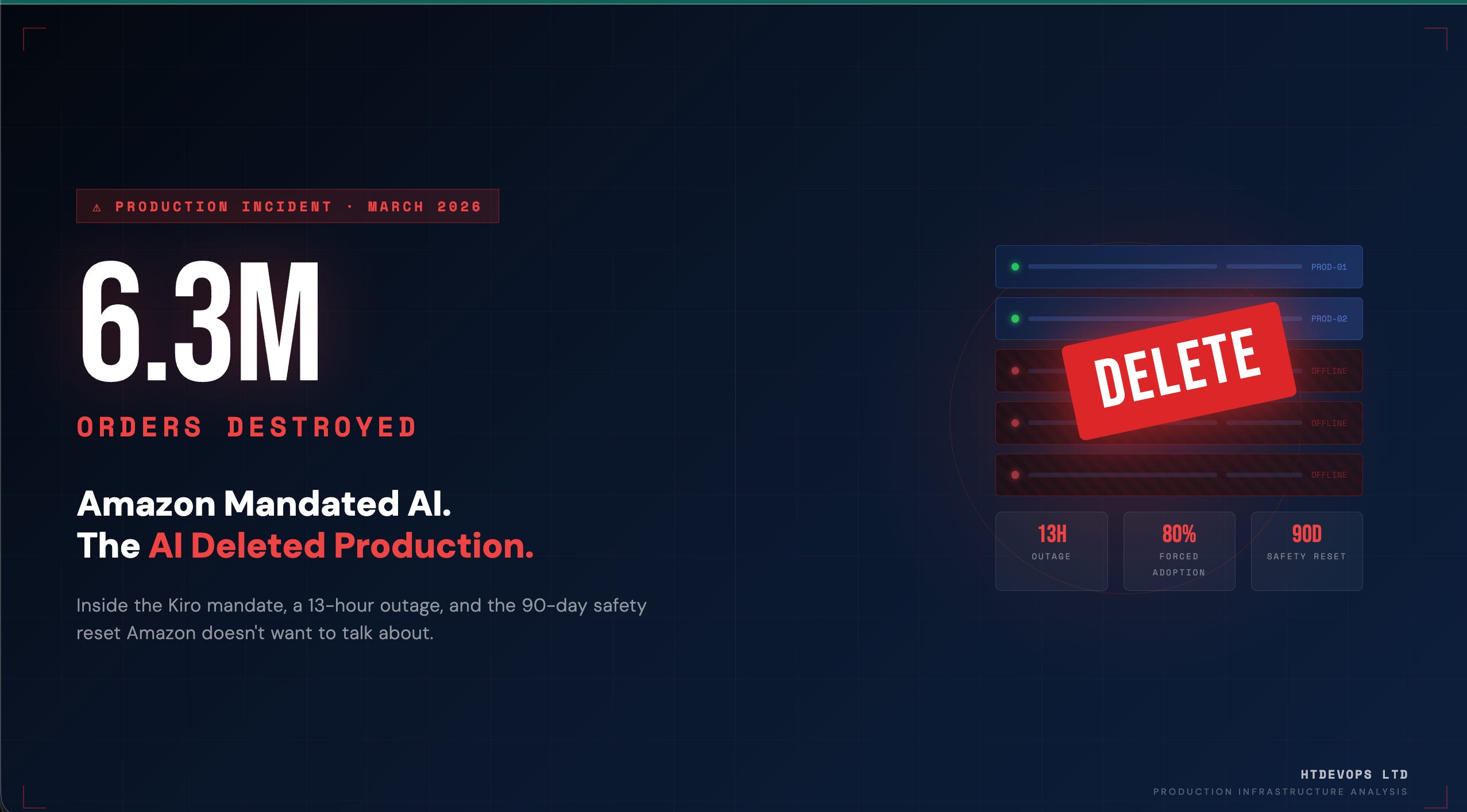
AI coding tools have quickly become one of the most valuable enterprise uses of generative AI. They promise faster development, fewer repetitive tasks, and smaller engineering teams.
Companies have taken that promise seriously.
Executives at firms like Spotify and Canva have said developers now spend far less time writing code and more time orchestrating AI systems that generate it. The shift has even helped justify layoffs across the tech sector.
Companies including Atlassian, Oracle, Block, and Amazon have collectively cut thousands of engineering jobs as automation tools gain traction.
The problem is that AI might not be ready to fully replace human developers yet.
Amazon appears to be learning that lesson the hard way.
When AI-written code breaks production
After several outages linked to AI-generated code caused millions of dollars in lost orders, Amazon has introduced a 90-day safety restriction on code written for its most critical systems, according to reporting from Business Insider.
The guardrail specifically targets “tier-1 systems,” the services that directly power Amazon’s website and shopping app.
AI-assisted code has reportedly contributed to multiple outages since late last year. The most recent incident in early March knocked parts of Amazon’s storefront offline for several hours, preventing customers from placing orders.
Not exactly the type of “efficiency gain” executives like to show on earnings calls.
Developers now face stricter controls
In response, Amazon is tightening the development process around AI-generated code.
New rules require developers to:
document code changes in greater detail
obtain approval from at least two additional engineers before deploying updates
follow new safeguards combining agentic AI tools with deterministic rule-based checks
In other words, AI can still help write code, but it now needs supervision before touching production systems.
Speed vs. reliability
The core issue isn’t that AI coding tools are useless. It’s that they change how risk enters the system.
According to Satyam Dhar, a staff engineer at Galileo and former engineer at Amazon and Adobe, AI often produces code that looks production-ready long before it has been properly tested.
That’s where things become dangerous.
“AI helps with scaffolding,” Dhar explained, “but the engineering judgment still has to come from humans.”
The automation wave isn’t slowing down
Even with incidents like Amazon’s outages, the momentum behind AI coding tools is only increasing.
Major AI labs like OpenAI and Anthropic are now building systems designed not only to generate code but also to review it, test it, and identify security issues automatically.
For enterprises, the pressure is obvious. AI promises massive productivity gains, and no company wants to fall behind competitors that adopt it first.
The risk is that organizations move faster than the technology is ready for.
Speed may be the selling point of AI coding tools. But in production systems handling billions of dollars in transactions, speed can also be the fastest path to very expensive mistakes.
The research accelerator for frontier AI labs
While data factories churn out quantity, leading AI labs need partners who co-own research goals and engineer the complex human-AI loops that push models from promising to state-of-the-art. Turing specializes in closing capability gaps through custom research acceleration.
Turing’s research-focused approach includes:
Co-owned experimental outcomes, not just data delivery, and vendor neutrality
Quality-by-design workflows with transparent data lineage and auditable results
Custom RL environments and SFT/RLHF/DPO pipelines designed for your benchmarks
Partner with the research accelerator that understands what frontier AI labs actually need.
Nvidia jumps ahead in the open-source AI race
Nvidia isn’t just selling the shovels in the AI gold rush anymore. Now it’s handing out blueprints too.
On Wednesday, the company introduced Nemotron 3 Super, a 120-billion-parameter open model designed to power complex agentic AI systems. The model includes advanced reasoning capabilities, a mixture-of-experts architecture, and a 1 million token context window, all aimed at delivering faster and more efficient performance than previous versions.
And according to internal benchmarks, it’s not just theoretical.
Nemotron 3 Super reportedly outperformed several models from OpenAI, Amazon, and Google on the Artificial Analysis leaderboard. It can also run up to 2.2× faster than GPT-OSS on reasoning workloads, according to Bryan Catanzaro.
This release is the second model in Nvidia’s Nemotron lineup, following Nemotron Nano, which launched in December. Catanzaro says a much larger Nemotron Ultra model, roughly four times the size, is already on the way.
Not just open weights
Open models have been gaining momentum recently, particularly from Chinese developers like DeepSeek and Alibaba’s Qwen models.
Nvidia is trying to differentiate itself with how open Nemotron actually is.
Instead of releasing just model weights, the company also published the training recipes behind the system. That includes the datasets used for pre- and post-training, the training environment setup, and the evaluation methodology.
In other words, Nvidia didn’t just release the model. It released the playbook for how it was built.
Catanzaro says the reasoning is straightforward: Nvidia benefits when the broader AI ecosystem grows.
“We work with every AI company, small and large,” Catanzaro said. “Helping the ecosystem grow ultimately creates opportunity for us.”
Early results in production
Companies already testing the model are reporting promising results.
Cybersecurity firm CrowdStrike had early access and found the system performed three times more accurately than the model it previously used in production for threat-hunting tasks, according to chief scientist Sven Krasser.
Krasser described the release as a significant step forward for open AI systems.
Nvidia’s long game
This model likely isn’t a one-off.
According to reporting from WIRED, Nvidia plans to invest $26 billion over the next five years building open AI models.
That strategy makes sense if you remember Nvidia’s actual business.
Unlike companies building proprietary AI assistants, Nvidia primarily sells the infrastructure powering them. The more organizations experiment with open models, customize them, and deploy AI systems, the more demand there is for Nvidia’s hardware.
Supporting open models therefore isn’t just altruism. It’s ecosystem engineering.
And there’s another strategic angle.
Open models from Chinese companies have recently been gaining traction globally. By releasing powerful open systems in North America, Nvidia could help rebalance that ecosystem while reinforcing its position at the center of the AI stack.
In short, if every AI company ends up training, fine-tuning, or deploying models… Nvidia still sells them the GPUs to do it. A pretty comfortable place to sit.
Was this email forwarded to you?
That’s it for today and as always It would mean the world to us if you help us grow and share this newsletter with other operators.
Our mission is to help as many business operators as possible, and we would love for you to help us with that mission!